

Divorce is stressful enough without the added burden of lengthy court battles. Mediation offers a different path-one where you and your spouse work with a neutral third party to reach agreements on your own terms.
We at Mediation First NJ LLC help families understand what mediation in a divorce case actually involves and how it can simplify the separation process. This guide walks you through how mediation works, its real advantages, and the myths that often hold people back from considering it.
How Mediation Actually Works
Understanding the Mediator’s Role
A mediator is not a judge, lawyer, or decision-maker. This distinction matters because it fundamentally changes how the process unfolds. The mediator facilitates conversation between you and your spouse, helps clarify what each person actually wants, and moves discussions forward when they stall. The mediator remains neutral throughout, never taking sides or pushing you toward outcomes they prefer. This neutrality allows both parties to feel heard rather than judged. According to a study published in The Journal of Consulting and Clinical Psychology from the University of Virginia, nonresidential parents who went through mediation were three times more likely to see their children weekly after 12 years compared to those who litigated. That long-term benefit stems directly from the mediator’s approach: creating space for genuine negotiation rather than adversarial positioning.
The Five Stages of Mediation
The mediation process unfolds in five distinct stages. First comes intake and orientation, where the mediator explains how sessions work, discusses fees, and may collect basic background information about your situation. Second, you gather and share financial documents-pay stubs, bank statements, asset and debt lists, children’s schedules-so both parties understand what actually needs to be divided.
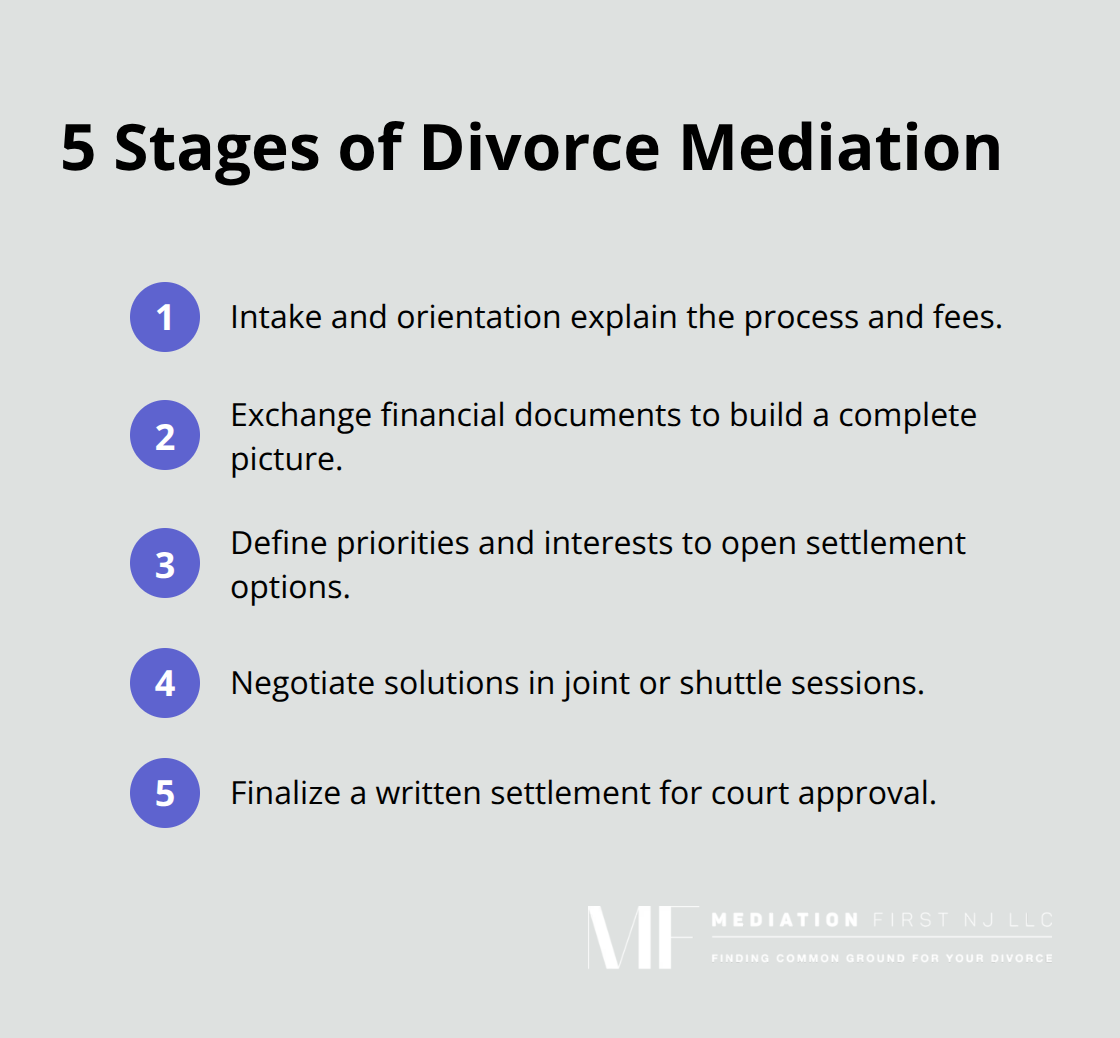
Third, you each articulate what matters most to you: custody arrangements, financial security, time with children, or specific assets. This stage opens settlement opportunities because overlapping interests emerge. Fourth, negotiation happens. You and your spouse, with the mediator’s help, brainstorm possible solutions and evaluate which ones address both parties’ priorities. The mediator may use separate sessions (called shuttle mediation) to prepare each spouse before joint discussions, though this adds time and cost. Fifth, once you reach agreement, the mediator drafts a settlement agreement that becomes legally binding once the court approves it.
Flexibility in Scheduling and Format
The entire process typically moves faster than litigation because you control the pace and focus on solutions rather than blame. You can schedule sessions around your work and family obligations, meeting in-person or online depending on what works for your situation. This flexibility means mediation adapts to your life, not the other way around.
What Issues Mediation Can Address
Issues you can address through mediation include child custody and parenting time, child support and spousal support, property division and debt allocation, and health insurance or retirement account arrangements. Essentially, any financial or parenting matter that would normally require court decisions can be negotiated in mediation. This power to craft agreements that actually fit your family’s unique circumstances sets mediation apart from court-imposed solutions. Understanding what mediation can accomplish prepares you to recognize its real advantages over traditional litigation.
Why Mediation Costs Less and Moves Faster
The Financial Reality of Litigation vs. Mediation
Mediation strips away the financial drain of traditional litigation. A contested divorce trial demands expert witnesses, discovery processes, depositions, and multiple court appearances-each adding thousands to your legal bill. Litigation routinely costs $15,000 to $30,000 or more per person, while mediation typically ranges from $3,000 to $8,000 total for both parties combined.
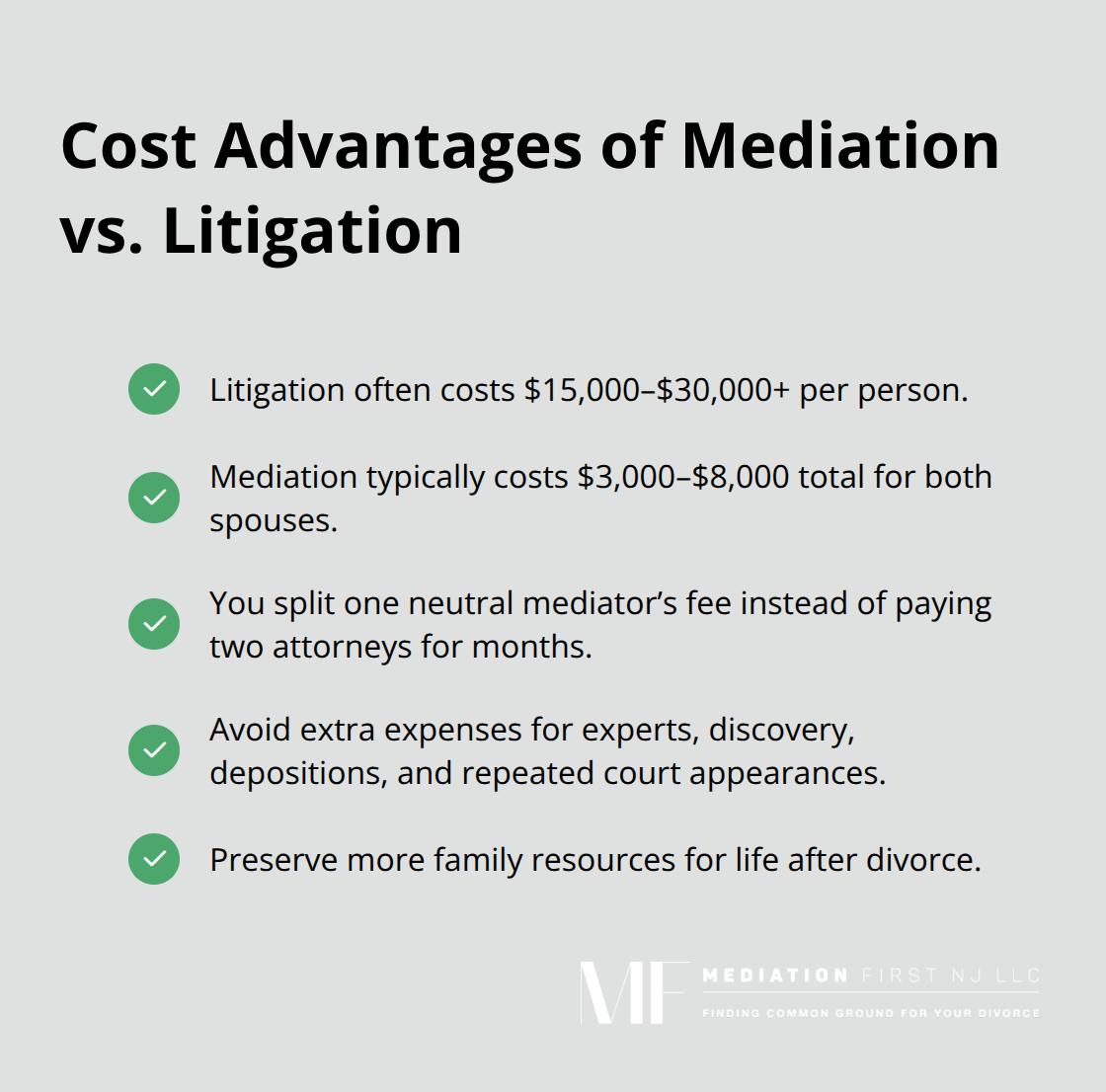
You split the mediator’s fee with your spouse rather than each paying separate attorneys for months of adversarial work. This difference alone makes mediation the practical choice for families who want to preserve resources for rebuilding after divorce.
Speed and Control Over Your Timeline
Court dockets are crowded; your case waits weeks or months between hearings. Mediation sessions happen on your schedule, often resolving core issues in three to six sessions spread across weeks rather than years. You control the pace and focus entirely on solutions instead of legal maneuvering. The practical result is straightforward: less money spent and more time available for work, family, and moving forward with your life.
Tailored Solutions That Fit Your Family
The control you retain in mediation translates directly into outcomes that actually fit your circumstances. A judge imposes decisions based on state law and courtroom arguments, not your family’s specific needs. You might lose custody arrangements that matter deeply to you or face asset divisions that leave you financially unstable. Mediation lets you negotiate solutions tailored to your children’s schedules, your financial reality, and your co-parenting goals. If your spouse’s career demands travel, you craft a parenting schedule that accommodates that instead of fighting over rigid court-ordered time. If you want to keep the family home while your spouse prioritizes retirement savings, you negotiate that trade directly rather than accepting whatever a judge decides.
Long-Term Relationship Benefits
Research from the University of Virginia shows that nonresidential parents who mediated were four times more likely to talk with their children weekly after 12 years compared to those who litigated. This durability stems from both parties having genuine input rather than feeling defeated by a court ruling. Mediated agreements foster better long-term relationships because both spouses participated in crafting the outcome.
Privacy and Confidentiality Protection
You maintain confidentiality throughout mediation; settlements remain private unless filed with the court, protecting your family’s sensitive financial and parenting information from public court records. This privacy advantage means your divorce details never become part of the public record that anyone can access. When you move forward with mediation, you protect not just your finances but also your family’s dignity during a vulnerable transition.
What Mediation Actually Requires From You
Many people assume mediation demands that you and your spouse already agree on everything, or that a mediator will impose decisions like a judge does, or that mediation only works if you’re on friendly terms. These misconceptions prevent families from exploring a process that could save them tens of thousands of dollars and months of conflict. The reality is far more flexible than most people realize.
You Don’t Need to Agree Before You Start
Mediation does not require pre-existing agreement. You and your spouse can arrive with completely opposing positions on custody, finances, and assets. The mediator’s job is to help you move from those opposing positions toward workable solutions, not to force consensus before you start.
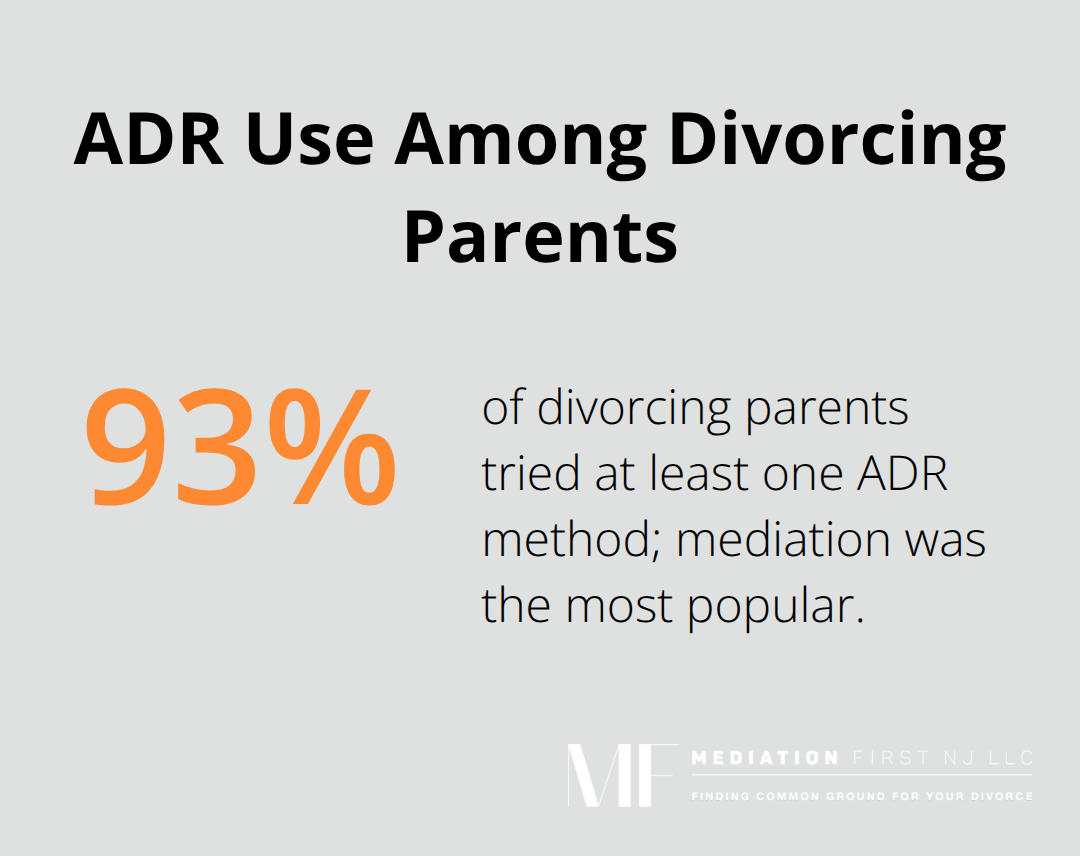
A Custody X Change study found that 93 percent of divorcing parents tried at least one alternative dispute resolution method, and mediation was the most popular choice among those methods. Many of those parents came to mediation with significant disagreements. What matters is willingness to negotiate in good faith, not whether you already see eye-to-eye. The mediator uses separate sessions and joint discussions to clarify what each party actually needs versus what they simply want, which often reveals room for compromise that wasn’t visible at the start.
The Mediator Doesn’t Make Your Decisions
The second misconception-that mediators make decisions for you-misunderstands the entire process. The mediator doesn’t make your decisions on custody arrangements, support amounts, or property division. You and your spouse make those decisions together. The mediator facilitates the conversation, proposes options when you’re stuck, and ensures both parties understand the implications of what they’re agreeing to, but the power to accept or reject any proposal stays with you. This differs fundamentally from litigation, where a judge imposes an outcome neither party controls.
High Conflict Doesn’t Disqualify You
Mediation succeeds even when emotions run high and relationships are fractured. The structure of mediation-separate sessions, a calm neutral presence, and focus on problem-solving rather than blame-actually helps high-conflict couples reach agreements they couldn’t negotiate alone. What mediation cannot handle is active domestic violence or situations where one party is hiding significant assets or engaging in serious deceit. If safety concerns exist, traditional legal processes with protective measures are appropriate. For most divorcing couples facing normal conflict and disagreement, mediation works regardless of whether the relationship ended amicably or acrimoniously.
Final Thoughts
Mediation in a divorce case offers a fundamentally different approach to separation than traditional litigation. You retain control over outcomes, spend significantly less money, and resolve issues faster by working with a neutral mediator rather than fighting through the court system. The process works regardless of whether you and your spouse currently agree on anything, because the mediator’s role is to facilitate negotiation, not impose decisions.
Research consistently shows that families who mediate maintain stronger long-term relationships and better co-parenting arrangements than those who litigate, with nonresidential parents staying more involved in their children’s lives years after the divorce concludes. This durability stems from both parties having genuine input rather than feeling defeated by a court ruling. When you understand what mediation in a divorce case actually involves, you recognize its real advantages over traditional litigation.
Start by gathering your financial documents and thinking through what matters most to you beyond your opening position. Flexibility and willingness to compromise increase settlement chances significantly, and Mediation First NJ LLC can help you navigate this process with professional mediation services that prioritize constructive communication and collaboration.