

When your marriage ends, you face a fundamental choice: litigation or mediation. The path you select shapes your finances, timeline, and family relationships for years to come.
At Mediation First NJ LLC, we’ve guided hundreds of couples through this decision. This guide breaks down mediation versus divorce litigation so you can make an informed choice based on your specific situation.
How Mediation Differs from Traditional Divorce
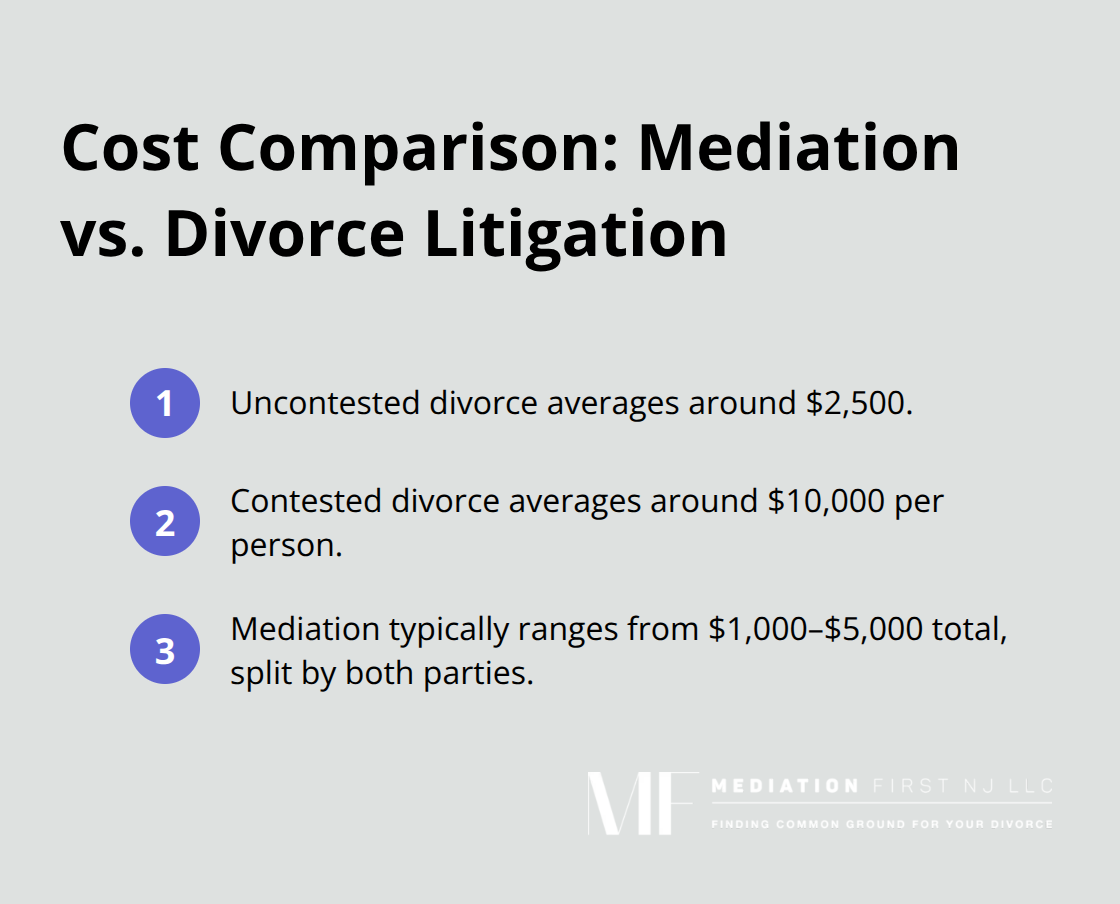
Mediation and litigation operate on completely different financial and temporal models, and the numbers reveal why most divorcing couples choose mediation. In Missouri, uncontested divorces average around $2,500, while contested divorces average around $10,000 per person. Mediation typically ranges from $1,000 to $5,000 total, split between both parties. This isn’t a modest difference-it’s the gap between one person’s annual car payment and a down payment on a house. The cost advantage grows sharper when cases involve contested issues; litigation expenses climb steeply as attorneys prepare for trial, conduct discovery, and attend multiple court appearances. Mediation keeps costs predictable because you control the number of sessions and the pace of negotiation. You don’t wait for court dockets to clear or pay hourly rates while your attorney waits in a courthouse hallway.
Speed Matters When Children Are Involved
Court dockets are congested. A contested divorce in litigation can stretch across months or years before a judge issues a final ruling. Mediation resolves most cases in weeks because you set the schedule, meeting when both parties and the mediator have availability. Research by Shaw in 2010 documented that mediated divorces close faster than adversarial cases, and you maintain control over the outcome rather than accepting whatever a judge decides.
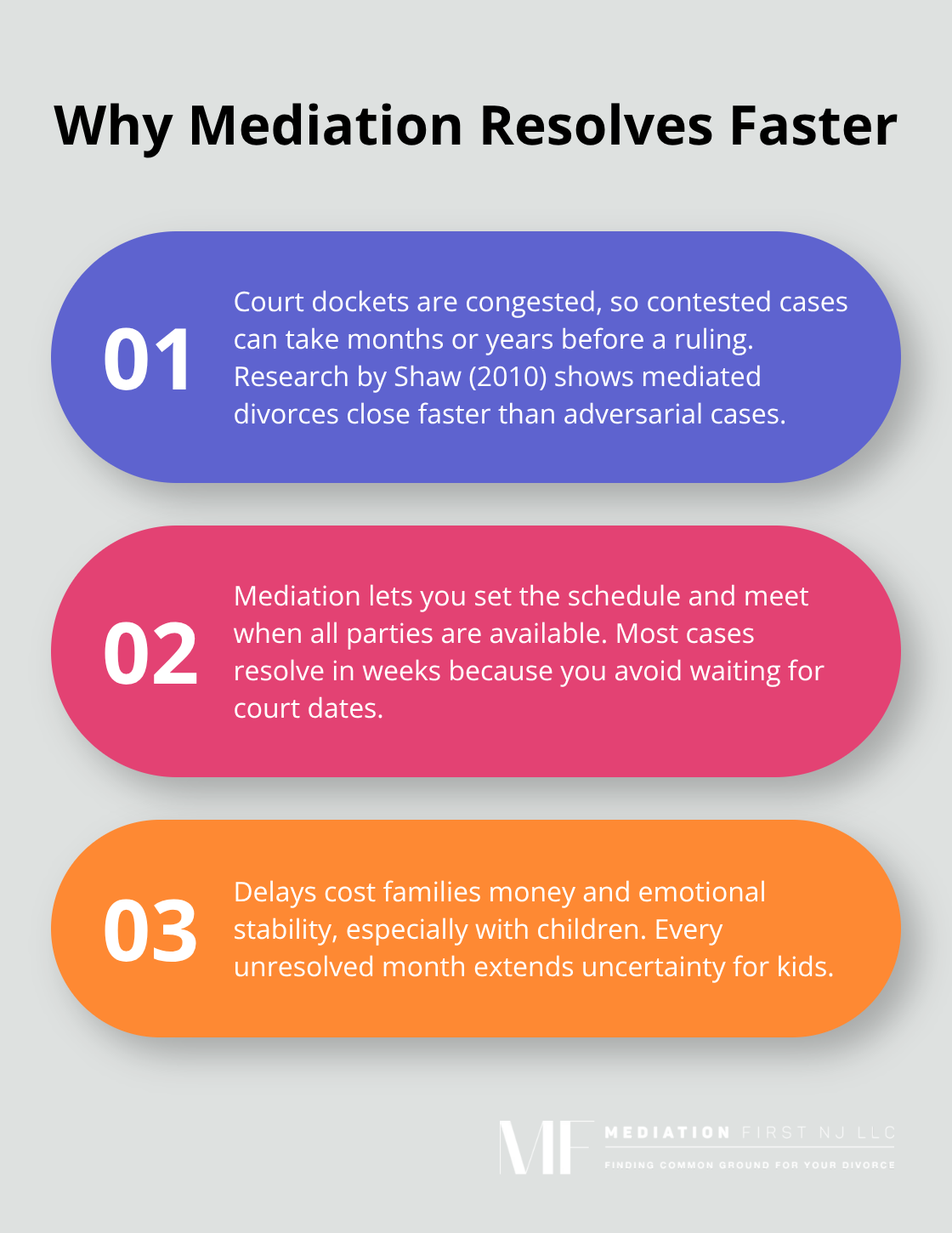
When children are in the picture, delay costs money-ongoing childcare arrangements, separate households, legal fees accumulating-and it costs emotional stability. Each month a case remains unresolved extends the period of uncertainty your children experience.
Who Decides Your Future
This difference is fundamental. In litigation, a judge reviews evidence and makes binding decisions about property division, custody, support, and parenting time based on state law and the judge’s interpretation of your case. You lose decision-making power. In mediation, you and your spouse craft the agreement together with a neutral facilitator. You can create arrangements that reflect your family’s actual needs-flexible custody around work schedules, phased property transfers, or creative support arrangements-because you’re not confined to standard court orders. Research by Emery, Sbarra, and Grover in 2005 found that mediated divorces result in higher satisfaction with outcomes because the terms align with what people actually want, not what a judge thinks is fair.
The Privacy Factor
Litigation exposes your family’s financial details, parenting struggles, and personal conflicts to public court records. Mediation keeps these conversations confidential. Only your final agreement becomes part of any public filing, and the negotiation process itself remains private. This protection matters especially when you share community ties, business interests, or want to shield your children from courtroom drama.
Moving Forward with Clarity
The path you choose determines not just how quickly your divorce concludes, but how much control you retain and what your family’s financial reality looks like afterward. Understanding these three core differences-cost, timeline, and decision-making power-positions you to evaluate which approach fits your circumstances and goals.
Key Advantages of Choosing Mediation
Children Adjust Better When Parents Collaborate
Research by Emery, Sbarra, and Grover in 2005 demonstrated that children in mediated divorces experience measurably better adjustment outcomes and lower inter-parental conflict over time compared to those whose parents litigated. School performance, behavioral stability, and the child’s ability to maintain healthy relationships with both parents all improve when mediation replaces courtroom conflict. Mediation removes children from the adversarial crossfire that litigation creates. In court disputes, children often become witnesses to parental hostility, courtroom arguments, and strategic maneuvering that serves no one’s interests.
Privacy Protects Your Family’s Sensitive Information
Mediation keeps the negotiation process private and collaborative, so children never sit in a waiting room outside a courtroom or hear their parents’ intimate details read aloud by attorneys. The confidentiality built into mediation means your family’s financial struggles, parenting disagreements, and personal conflicts stay between you, your spouse, and the mediator. Court records are public-anyone can access details about your assets, custody disputes, or support arrangements. Mediation documents remain private unless you choose to file the final agreement with the court.
Business owners particularly benefit because sensitive financial details about company value or income don’t become public record. Families with community ties avoid having neighbors or colleagues learn intimate details through courthouse gossip or online court databases.
Mediation Creates a Workable Foundation for Co-Parenting
Mediation fundamentally changes how you and your ex-spouse interact after divorce concludes. When a judge imposes terms, resentment lingers because one or both parties feel the outcome was unfair or forced upon them. When you and your spouse craft an agreement together-even with significant disagreement during the process-you’ve both invested in the solution. Studies from Shaw in 2010 found that parties who mediate report higher satisfaction with outcomes and higher compliance with agreements.
You’ll coordinate school pickups, handle illness decisions, navigate holiday schedules, and support your children’s activities for years or decades. A mediated agreement that reflects both parents’ actual values gets honored more consistently. Flexible custody arrangements around work schedules, phased transitions for children between households, and support terms that both parties genuinely agreed to receive better adherence over time.
Collaborative Problem-Solving Establishes Lasting Patterns
The mediator helps you identify common ground on what matters most-often discovering that both parents prioritize the children’s stability and want to remain involved. This collaborative process establishes the communication pattern you’ll need going forward. You practice respectful negotiation during mediation, which becomes the template for future co-parenting conversations. This foundation matters when you face custody modifications, school decisions, or unexpected life changes that require ongoing cooperation between former spouses.
Understanding these advantages positions you to evaluate whether mediation aligns with your family’s needs and your vision for life after divorce.
Common Misconceptions About Mediation
Mediation Works Only for Amicable Couples
The most damaging myth about mediation is that it only works for couples who still like each other. This misconception stops people from pursuing the fastest, cheapest path to resolution before they even try. The truth is far more practical: mediation works when both parties are willing to negotiate in good faith, not when they’re best friends. You don’t need to enjoy your spouse’s company. You need to be willing to sit in a room and discuss property division, custody, and support without the conversation dissolving into personal attacks.
Research consistently shows that mediated divorces succeed across a spectrum of relationship conditions. What matters is whether you can separate the emotional wound of the failed marriage from the practical business of dividing assets and arranging parenting time. Many couples who describe their relationship as hostile or broken still reach mediated agreements because the mediator structures the conversation around interests, not emotions. If you can’t have that conversation without a neutral third party present, mediation is exactly what you need, not what you should avoid.
Mediators Don’t Make Decisions Like Judges
The second misconception treats the mediator as a judge in disguise. A mediator doesn’t hear arguments and render decisions. The mediator facilitates negotiation, suggests solutions based on what other families have done, and drafts the agreement you and your spouse actually reach. You retain complete control. A judge imposes terms; a mediator helps you craft them.
This distinction matters enormously for enforceability. Agreements you’ve both signed because you genuinely agreed to them get honored. Court-imposed orders breed resentment and non-compliance. When you craft a solution together, you’ve invested in the outcome, and that investment translates into better adherence over time.
Mediation Provides Legal Protection
The third false belief holds that mediation leaves you legally unprotected. In reality, we recommend that you consult an attorney before, during, or after mediation to review the agreement for fairness and legal soundness. Many couples hire lawyers to accompany them to mediation sessions or to review the final draft before filing. The mediator cannot provide legal advice, but your attorney can.
This combination of mediation’s efficiency with legal review creates protection without the cost explosion of full litigation. You’re not choosing between mediation with no legal oversight and litigation with full legal protection.

You’re choosing how much legal support you want alongside mediation, and most people find that modest attorney involvement provides confidence without the expense of contested divorce.
Final Thoughts
Mediation versus divorce litigation presents a clear choice between control and uncertainty, affordability and expense, privacy and public exposure. Couples who mediate spend less money, resolve disputes faster, and report higher satisfaction with their agreements. Children adjust better when parents collaborate rather than battle in court, and your family’s financial details stay confidential.
Assess your situation honestly to determine if mediation fits your circumstances. Ask yourself whether you can communicate without constant hostility, whether both parties will negotiate in good faith, and whether you want to protect your children from courtroom conflict. Even if communication is strained, mediation often works because the mediator structures conversations around practical interests rather than emotional wounds. Situations requiring caution include active domestic violence, significant power imbalances, or evidence of asset hiding, where court intervention may provide necessary protection.
We at Mediation First NJ LLC specialize in guiding individuals and families through divorce and family disputes with a focus on constructive communication and collaborative problem-solving. Contact us to discuss whether mediation aligns with your circumstances, and consider consulting an attorney to review any agreement before finalizing it.