

Divorce doesn’t have to mean years of courtroom battles and mounting legal bills. Mediation offers a faster, more affordable path forward where you maintain control over decisions that affect your family.
At Mediation First NJ LLC, we’ve seen firsthand how mediation transforms divorce outcomes. When both parties work with a neutral mediator, agreements stick because people helped create them.
Why Mediation Delivers Better Results Than Court
Mediation Creates Agreements That Stick
Mediation produces outcomes that stick because the people involved actually built them. A University of Virginia study published in The Journal of Consulting and Clinical Psychology tracked divorced families over 12 years and found something striking: parents who mediated stayed far more involved with their children than those who litigated. The nonresidential parent was three times more likely to see their children weekly after mediation compared to litigation, and four times more likely to talk to them weekly. That difference matters for your family’s future.
When you work out an agreement in mediation, you own it. You made the decisions. You understand why each provision exists.
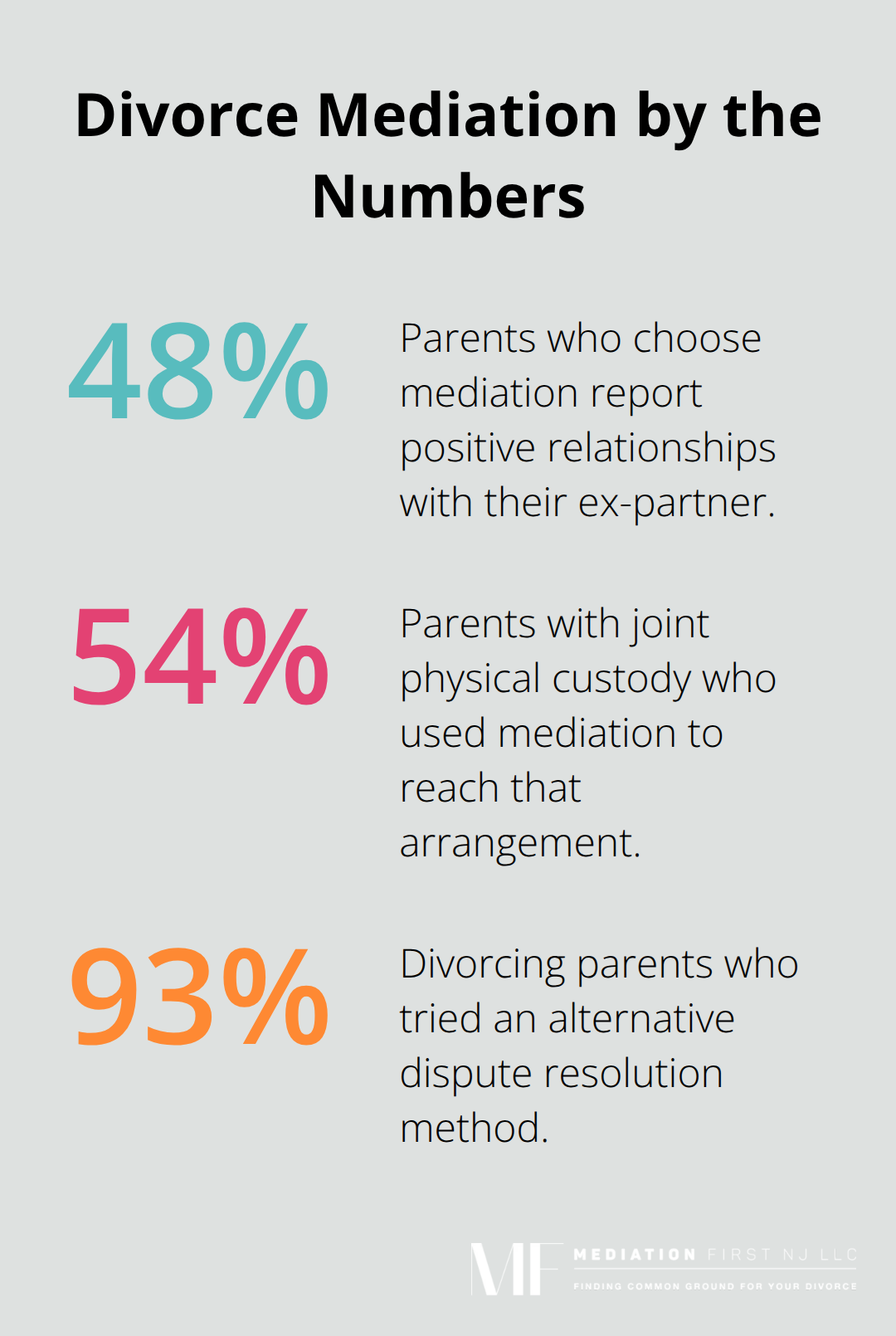
That ownership translates directly into compliance, which means fewer conflicts down the road and more stable arrangements for everyone involved. Research shows that 48% of parents who choose mediation report positive relationships with their ex-partner, compared to the adversarial outcomes typical of court battles.
Court Removes You From the Decision-Making Process
Litigation pits you against your spouse in front of a judge who has never met your family and spends maybe a few hours reviewing your case. The judge decides what happens to your assets, your children, and your financial obligations based on legal rules, not what actually works for your life. You lose control the moment the gavel comes down.
Mediation rejects this entirely. You and your spouse craft solutions together with a neutral facilitator who has no power to impose anything. The mediator simply helps you talk through options and explore creative arrangements that litigation would never produce. You might agree to flexible custody schedules that match your work reality, asset splits that account for future earning potential, or support arrangements that adapt as circumstances change. None of that happens in court because judges work within rigid frameworks.
Litigation Costs Far More Than Mediation
Litigation in New Jersey devours resources in ways mediation simply does not. Court battles involve depositions, discovery motions, expert witnesses, trial preparation, and courtroom time-all billable hours that accumulate quickly. A contested divorce through litigation routinely costs tens of thousands of dollars or more depending on complexity and how long it stretches.
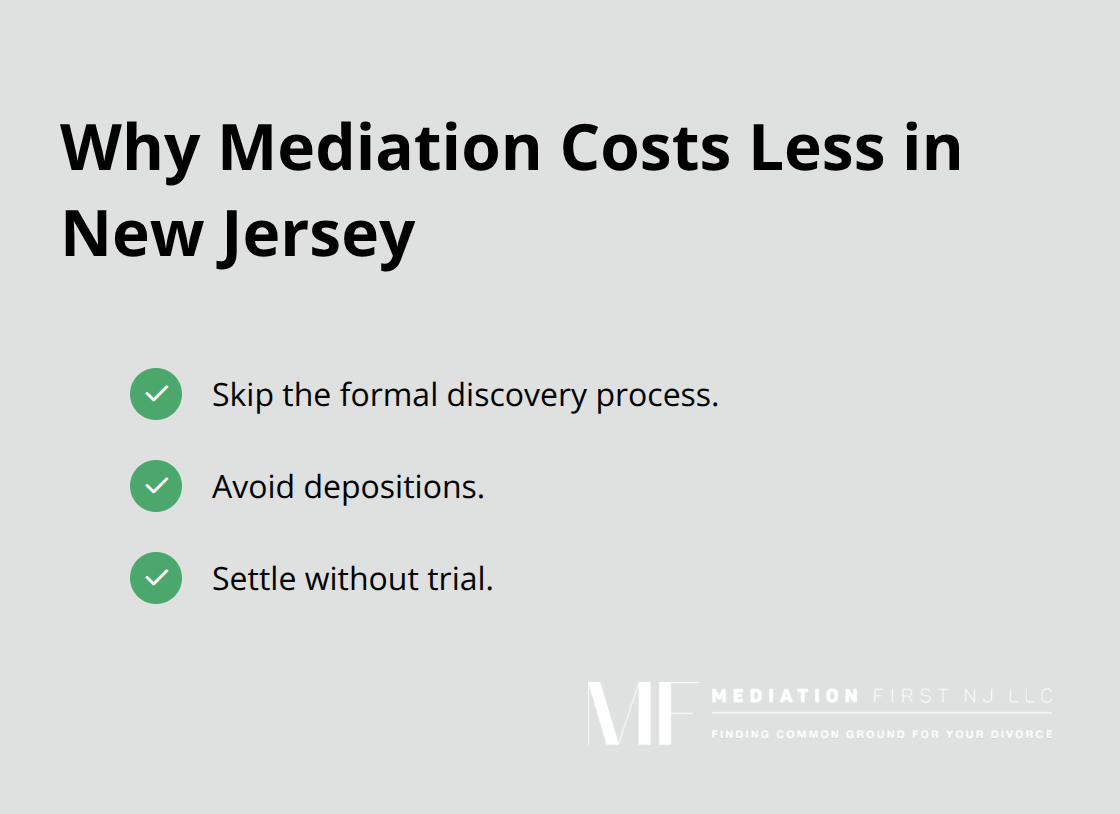
Mediation typically costs a fraction of that amount because you skip the formal discovery process, avoid depositions, and settle without trial. Most mediated divorces in New Jersey cost between $3,000 and $8,000, while litigated divorces often hit $15,000 to $50,000 or more per spouse.
Cost matters because it affects your ability to move forward. When legal fees drain your resources, you have less money to rebuild your life and support your children properly.
These concrete differences-better long-term parenting outcomes, real control over decisions, and dramatically lower costs-explain why mediation works so well for families ready to move past conflict. What mediation can actually resolve depends on your specific situation and what issues matter most to your family.
What Mediation Can Resolve
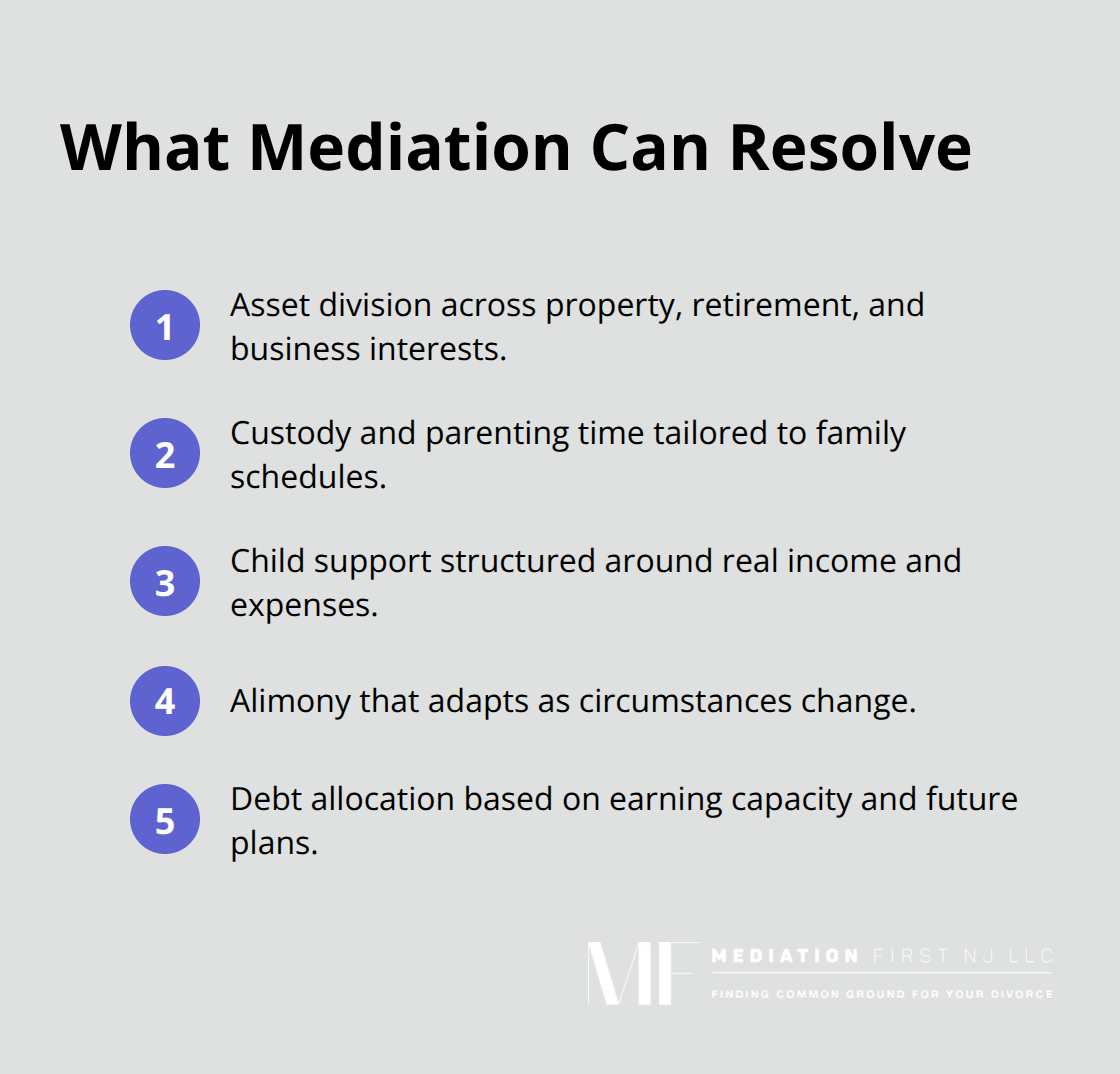
Mediation handles the full range of divorce issues that would otherwise go to court, and the breadth of what gets resolved matters because it addresses everything in one collaborative process rather than fighting multiple battles. Asset division, custody arrangements, and support obligations all sit on the table at once, which prevents the fragmentation that happens in litigation where different issues get decided separately by a judge who may lose sight of how one decision affects another.
Property and Debt Split Without a Judge’s Rigid Framework
Asset division in mediation works differently than court because you are not constrained by the judge’s interpretation of equitable distribution laws. New Jersey follows equitable distribution, which sounds fair but in practice means a judge applies legal formulas that ignore your actual circumstances. Mediation lets you propose splits that account for factors a judge would never consider: one spouse keeps the family home while the other receives a larger retirement account, or staggered transfers of assets that match your cash flow reality rather than forcing immediate liquidation. You might agree that one spouse keeps the business they built while the other receives a corresponding share of investment accounts. These arrangements stick because both people crafted them and understand the reasoning. In litigation, the judge decides, and someone walks out feeling the division was unfair even if it technically followed the law.
Debt allocation works the same way. You can decide who pays what credit card balance, who carries the mortgage, and who handles student loans based on earning capacity and future financial plans rather than letting a judge simply split everything fifty-fifty regardless of whether that makes sense for your situation.
Custody and Parenting Time Tailored to Real Life
Court-ordered custody arrangements follow templates: alternating weekends, midweek visits, holiday schedules locked into rigid patterns. Mediation produces parenting plans that actually work for how your family operates. One parent might have weekday custody while the other handles extended weekends because of work schedules. School breaks might split differently than holidays because one parent travels for work in summer. Teenagers might have input on their schedule rather than a judge imposing something that ignores their activities and preferences.
A Custody X Change study found that 54 percent of parents with joint physical custody used mediation to reach that arrangement, which suggests mediation produces shared parenting outcomes more frequently than litigation does. The data matters because joint custody requires cooperation, and mediation builds that foundation from the start. When both parents negotiate the schedule together with a mediator, they understand each other’s constraints and priorities. That understanding carries forward into actual parenting, which reduces conflict and keeps children out of the middle.
Support Arrangements That Adapt to Your Actual Finances
Child support and alimony calculations in court follow statutory guidelines, which means a judge plugs numbers into a formula and out comes an amount. That formula ignores whether one parent has significant debt, whether childcare costs spike at certain ages, or whether your earning potential is about to change. Mediation lets you build support arrangements that reflect your real financial picture. You might agree on lower initial support that increases when a professional license gets completed or a business stabilizes. You could structure payments to account for seasonal income fluctuations if one spouse works in a cyclical industry. You might agree that one parent covers specific expenses like health insurance or private school rather than paying cash support, which sometimes reduces total outflow while meeting everyone’s actual needs.
These agreements work better long-term because they rest on honest conversation about what money actually flows in and out, not on what a formula says should happen. When support arrangements match financial reality, compliance rates improve because the paying spouse can actually afford the payments without resentment building up. The issues you resolve in mediation form the foundation for what comes next: the practical steps that transform agreements into reality and protect your interests as you move forward.
Common Misconceptions About Divorce Mediation
Both Parties Must Agree Before Mediation Starts
Many people assume mediation demands that both spouses already agree on everything before walking into a mediator’s office. This misconception stops people from even trying mediation because they think disagreement disqualifies them. The truth is the opposite: mediation exists precisely because people disagree. If you and your spouse already agreed on asset division, custody, and support, you would not need a mediator at all. You would simply hire an attorney to draft the paperwork.
Mediation works when you disagree but are willing to sit down and explore solutions with a neutral person guiding the conversation. One spouse might want the house while the other needs cash liquidity, or one parent envisions shared custody while the other prefers a different arrangement. These conflicts are exactly what mediation addresses. The mediator does not demand agreement beforehand; they facilitate the discussion that leads to agreement. Starting mediation with disagreement is normal and expected, not a barrier to success.
The Mediator Acts as a Judge
Another widespread myth is that a mediator acts like a judge who will tell you who is right and who is wrong. This misunderstanding causes people to worry that mediation means presenting your case to someone who will ultimately side with one party. That is not what happens. A mediator has no authority to decide anything. They cannot impose an outcome, declare one spouse guilty of wrongdoing, or force a settlement.
Their job is to help you and your spouse communicate effectively, explore options you might not have considered, and reach agreements that work for both of you. A mediator stays neutral by design, which means they do not judge the merits of your position or your spouse’s position. They help you both see past positions to underlying interests. If one spouse claims the other hid assets, the mediator might suggest bringing in a financial professional to review records, but the mediator themselves will not investigate or judge. This neutrality is actually what makes mediation work: both parties trust the mediator because the mediator has no stake in the outcome.
Mediation Takes Longer Than Court
Many people believe mediation takes longer than going to court. The data contradicts this directly. A Custody X Change study found that 93 percent of divorcing parents tried an alternative dispute resolution method, and these parents moved through their divorces faster than those who litigated. Court calendars in New Jersey are packed with delays that can stretch a case over years.
Mediation sessions happen on your schedule, not a judge’s schedule. A straightforward mediation might resolve in three to five sessions over a few weeks or months. Even complex cases with significant assets or custody disputes typically resolve in fewer sessions than a litigated divorce takes just to reach trial, and that is before considering appeals or post-judgment disputes. The speed advantage compounds when you factor in the emotional toll of prolonged court battles versus the focused, solution-oriented approach mediation provides.
Final Thoughts
Mediation works for divorce when you want to move forward without the destruction that litigation creates. Court proceedings expose your financial details, custody disputes, and personal conflicts as public record, while mediation keeps everything confidential between you, your spouse, and the mediator. This privacy protects your reputation, shields your children from public scrutiny, and lets you rebuild without your divorce becoming neighborhood gossip.
Co-parenting after divorce determines whether your children thrive or struggle, and mediation builds the communication foundation that makes this possible. When you litigate, you teach your children that conflict resolves through winning and losing with a judge deciding who was right. A Custody X Change study found that 48 percent of parents who used alternative dispute resolution reported getting along very well or extremely well with their ex-partner, compared to far lower rates among those who litigated. Parents who mediate together develop communication skills they carry into post-divorce parenting for years to come.
Agreements that actually work are the final advantage of mediation, and this answers whether mediation is good for divorce. When you and your spouse build an agreement together, you create something you both understand and both want to follow because it reflects your actual circumstances, not a judge’s interpretation of equitable distribution. We at Mediation First NJ LLC help families reach these durable agreements by fostering constructive communication and collaboration that serves your family’s best interests.