

Family conflicts happen in every household, from money disputes to parenting disagreements. These tensions can damage relationships and create lasting stress for everyone involved.
We at Mediation First NJ LLC see families struggle with these issues daily. The good news is that effective family conflict resolution strategies can transform these challenges into opportunities for stronger bonds.
What Triggers Most Family Conflicts
Money Management Creates the Biggest Rifts
Financial disputes rank as the number one source of family conflict. About one-in-seven U.S. adults provide unpaid care of some kind to another adult, which intensifies money-related tensions when siblings disagree about cost allocation or inheritance decisions. Estate disputes destroy more family relationships than any other issue because emotions run high when people feel their financial security faces threats.
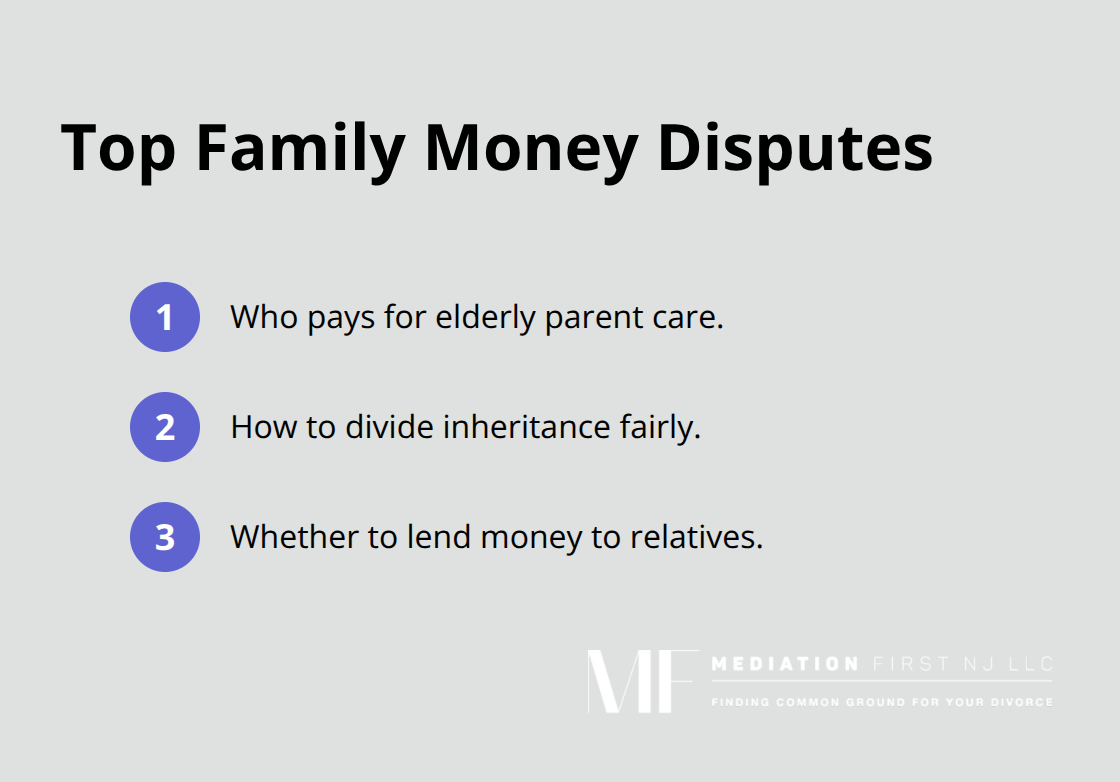
Families fight most over three specific money issues: who pays for elderly parent care, how to divide inheritance fairly, and whether to lend money to relatives. These conflicts escalate quickly because they involve both practical concerns and deep feelings about fairness and family loyalty. The solution requires written agreements before problems arise, not after emotions have already damaged relationships.
Different Approaches to Child-Rearing Divide Families
Divorced parents create persistent conflict when their methods clash dramatically. Research from Sechrist and colleagues shows that shared beliefs lead to higher-quality family relationships, which explains why parents with opposite discipline methods struggle constantly. The most destructive disagreements happen over screen time limits, educational choices, and religious instruction because these decisions shape children’s futures.
Stepparent conflicts intensify these problems when new family members try to establish authority. Children often resist stepparent discipline, which creates loyalty conflicts that tear families apart. Grandparents who undermine parental decisions also fuel these disputes when they give mixed messages to children about family rules and expectations.
Communication Failures Amplify Every Other Problem
Poor communication transforms minor disagreements into major family crises. Gottman’s research identified four communication patterns that predict relationship failure: criticism, contempt, defensiveness, and stonewalling. Families who use these toxic patterns cannot resolve conflicts because they attack each other instead of address the actual problems.
The most damaging communication mistakes happen during high-stress situations (like family gatherings or medical emergencies). Family members make assumptions about others’ intentions, interrupt constantly, and bring up past grievances instead of focus on current issues. These patterns become deeply ingrained habits that require specific strategies to break effectively.
How to Break Destructive Communication Patterns
Replace Blame With Specific Observations
The most effective families abandon accusatory language completely and focus on specific behaviors instead. Research shows that I statements reduce defensiveness compared to you statements that trigger immediate emotional reactions. Instead of “you never listen to me,” successful families say “I feel unheard when conversations get interrupted.” This shift transforms conflicts from personal attacks into problem-solving discussions that actually produce solutions.
The speaker-listener technique requires one person to speak while the other paraphrases what they heard before responding. This method prevents the escalation that destroys family conversations because it forces people to actually understand each other before reacting. Families who cannot stop talking over each other see immediate improvement when they implement this approach.
Set Clear Conversation Rules Before Tensions Rise
Smart families establish ground rules during calm moments, not during heated arguments when emotions make rational thinking impossible. The most effective boundary is the 20-minute cooling-off period that research proves necessary for physiological arousal to decrease. Families who enforce this rule see conflict resolution improve dramatically because people cannot process social interaction when their heart rate exceeds 100 beats per minute.
Three non-negotiable rules prevent family discussions from becoming destructive fights: no interrupting until the speaker finishes their complete thought, no bringing up past conflicts during current discussions, and no name-calling or character attacks under any circumstances. These boundaries seem obvious, but most families violate them constantly because they never explicitly agree to follow them.
Master the Art of Neutral Language
Successful conflict resolution depends on word choice that reduces rather than increases emotional intensity. Replace “always” and “never” with specific timeframes like “this week” or “yesterday” to avoid sweeping generalizations that make people defensive. The phrase “that bothers me” becomes “I would prefer” because it removes the implied criticism that escalates tensions immediately.
The soft startup technique begins difficult conversations with appreciation rather than complaints. Start with something positive about the person before addressing the problem, which creates psychological safety that allows productive discussion. This approach works because the human brain processes positive information first, making people more receptive to feedback that follows.
These communication strategies work best when families practice them consistently, but some conflicts require additional intervention. Professional mediation provides structured support when family members struggle to implement these techniques on their own, especially when relationship dynamics become particularly complex.
When Professional Mediation Beats DIY Solutions
Family Mediation Works When Communication Breaks Down Completely
Professional mediation becomes necessary when family members cannot have productive conversations despite repeated attempts with communication strategies. The clearest signal that families need outside help occurs when discussions immediately escalate to yelling, personal attacks, or complete silence from one or more parties. Families who cycle through the same arguments for months without resolution waste emotional energy and damage relationships further while professional mediators break these patterns in just a few sessions.
Three specific situations demand immediate professional intervention: when family members threaten to cut contact permanently, when children show behavioral problems due to ongoing family conflict, or when financial disputes exceed $10,000 in value. These circumstances require neutral third-party guidance because the emotional stakes make objective problem-solving nearly impossible for family members who act alone.
Mediation Costs 90% Less Than Court Battles
Family mediation typically costs between $150-$300 per hour with most conflicts that resolve in 3-6 sessions, which creates total costs of $900-$1,800 for complete resolution. Court litigation involves significant expenses including court filing fees and costs related to gathering evidence, which makes mediation the financially superior choice for families who want to preserve relationships and resources simultaneously.

How Mediation Differs From Other Approaches
The process differs fundamentally from therapy because mediators focus on specific agreements rather than emotional healing, and from litigation because families maintain control over outcomes instead of judges who make binding decisions. Successful mediation produces written agreements that family members create together, which increases compliance rates compared to court orders that people often resist or ignore.
Professional Mediators Break Destructive Patterns Fast
Trained mediators identify communication roadblocks that families cannot see themselves and introduce structured techniques that prevent escalation. They create safe environments where each person can express concerns without interruption or judgment (something families struggle to achieve on their own). Most importantly, mediators remain neutral and help families focus on solutions rather than blame, which transforms adversarial dynamics into collaborative problem-solving sessions that actually produce lasting agreements.
Final Thoughts
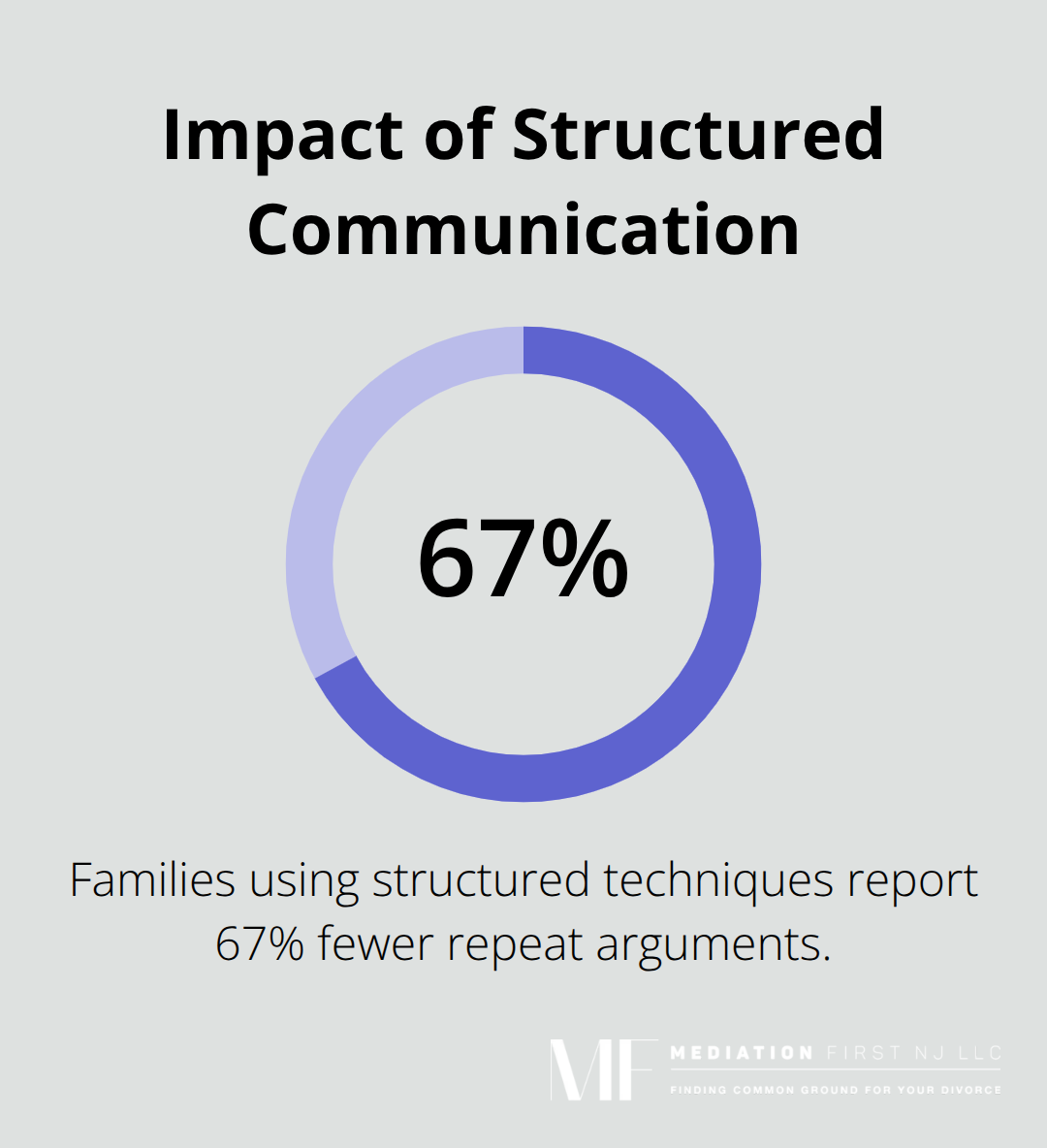
Families who invest in proper family conflict resolution see remarkable transformations within months. Research shows that households use structured communication techniques and report 67% fewer arguments that repeat over time. Children in these families demonstrate better academic performance and fewer behavioral issues because they witness healthy problem-solving instead of destructive patterns.
The ripple effects extend beyond immediate family members. Extended relatives notice the positive changes and often adopt similar approaches, which creates healthier dynamics across entire family networks. Parents who master these skills pass them to their children and break cycles of poor communication that damage relationships for decades.
Professional mediation accelerates this process dramatically. Families work with trained mediators and resolve conflicts in weeks rather than years (which preserves precious time and emotional energy). Mediation First NJ LLC provides professional guidance for New Jersey families ready to transform their conflicts into stronger connections through collaborative problem-solving that prioritizes everyone’s needs.