

Divorce mediation sounds appealing until you hit real obstacles. One spouse might refuse to negotiate fairly, financial disputes can spiral into complexity, and emotions often boil over in joint sessions.
We at Mediation First NJ LLC know that understanding the downsides to divorce mediation helps you make informed decisions about your path forward.
When Mediation Stalls and Breaks Down
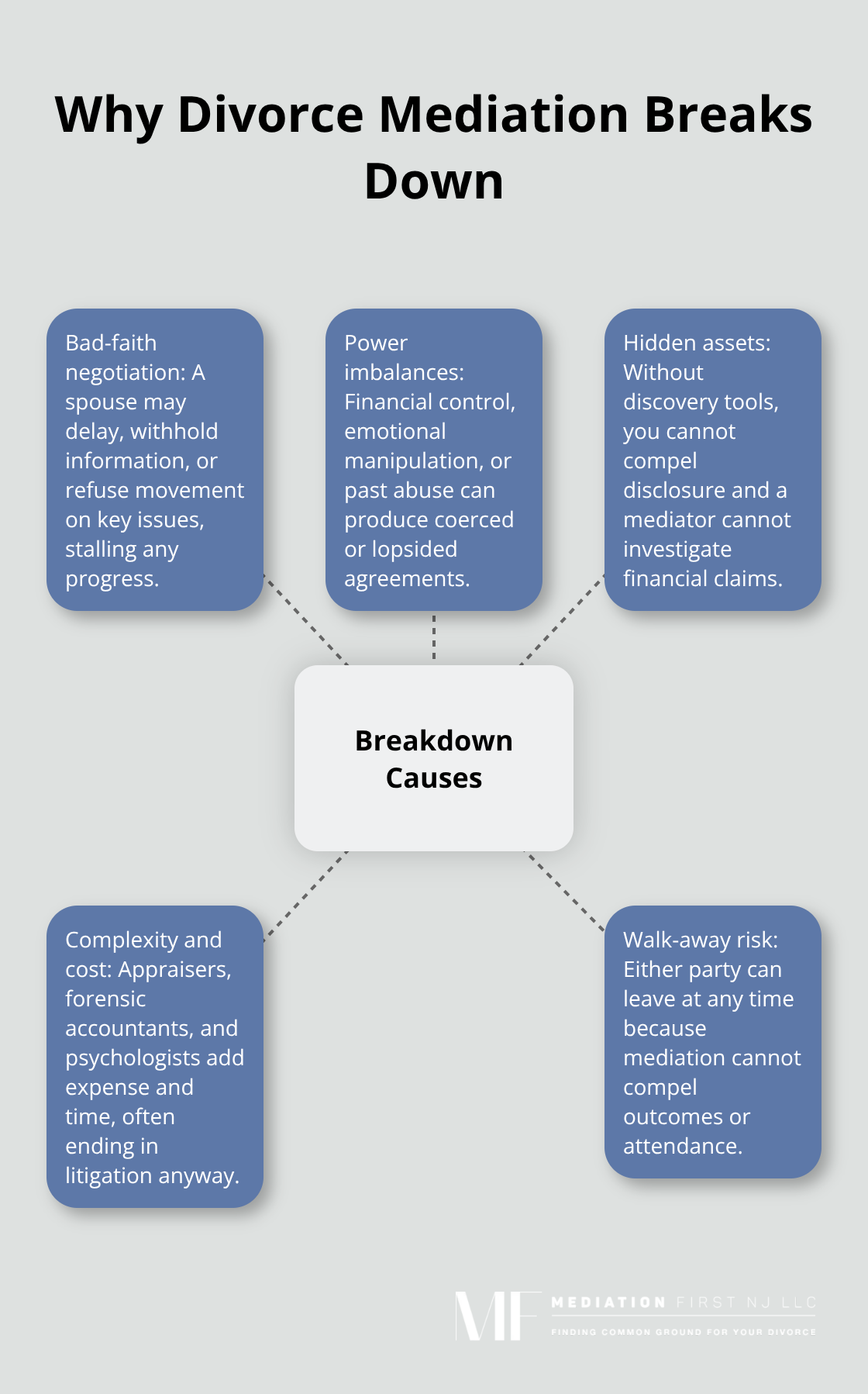
One Spouse Refuses to Negotiate in Good Faith
Mediation collapses most often when one spouse stops negotiating honestly. This happens far more frequently than people expect. One party may agree to mediation initially, then use the process to delay, withhold information, or simply refuse to budge on key issues. Research on intimate partner violence in divorce mediation shows that cases entering divorce mediation may involve intimate partner violence, which can manifest as one spouse intimidating or controlling the other during sessions, making genuine negotiation impossible.
Power Imbalances Prevent Fair Agreements
When power imbalances exist-whether from financial control, emotional manipulation, or past abuse-the weaker party struggles to voice their actual needs. They may appear to agree just to escape the session, then later reject the settlement or claim they were coerced. If your spouse has significantly more income, assets, or social power, mediation often produces agreements that heavily favor them.
Hidden Assets Undermine the Process
You might also face situations where your spouse simply refuses to disclose assets. Unlike court discovery, mediation has no legal mechanism to force transparency. If you suspect hidden accounts, offshore funds, or undervalued business interests, mediation becomes nearly worthless because you cannot compel truthful financial disclosure. The mediator cannot investigate; they can only facilitate discussion.
Complex Cases Require Outside Professionals and Additional Costs
Complex custody or financial cases frequently require outside professionals-appraisers for real estate, forensic accountants for hidden income, psychologists for parenting evaluations. These add significant cost and time, potentially making mediation more expensive than a straightforward court process. When mediation reaches an impasse on these issues, you still need to litigate, meaning you pay for both the failed mediation sessions and the subsequent court battle. You spend months in mediation without resolution, then restart from scratch in litigation.
Either Party Can Walk Away at Any Time
Some mediators pressure both spouses to compromise even when one party’s position is unreasonable or legally unsound. Without an attorney present to advise you on your actual rights, you may accept a settlement far worse than what a judge would award. Mediation also cannot compel outcomes; if your spouse simply walks away from the table and refuses to return, you have no recourse except litigation. One party can derail the entire process at any time, leaving you back in court but with additional mediation costs already spent. This reality raises a critical question: whether mediation actually works when breakdowns occur, and you must still address costs and time lost in the process.
What Actually Happens to Your Wallet During Mediation
Mediator Fees Stack Up Quickly
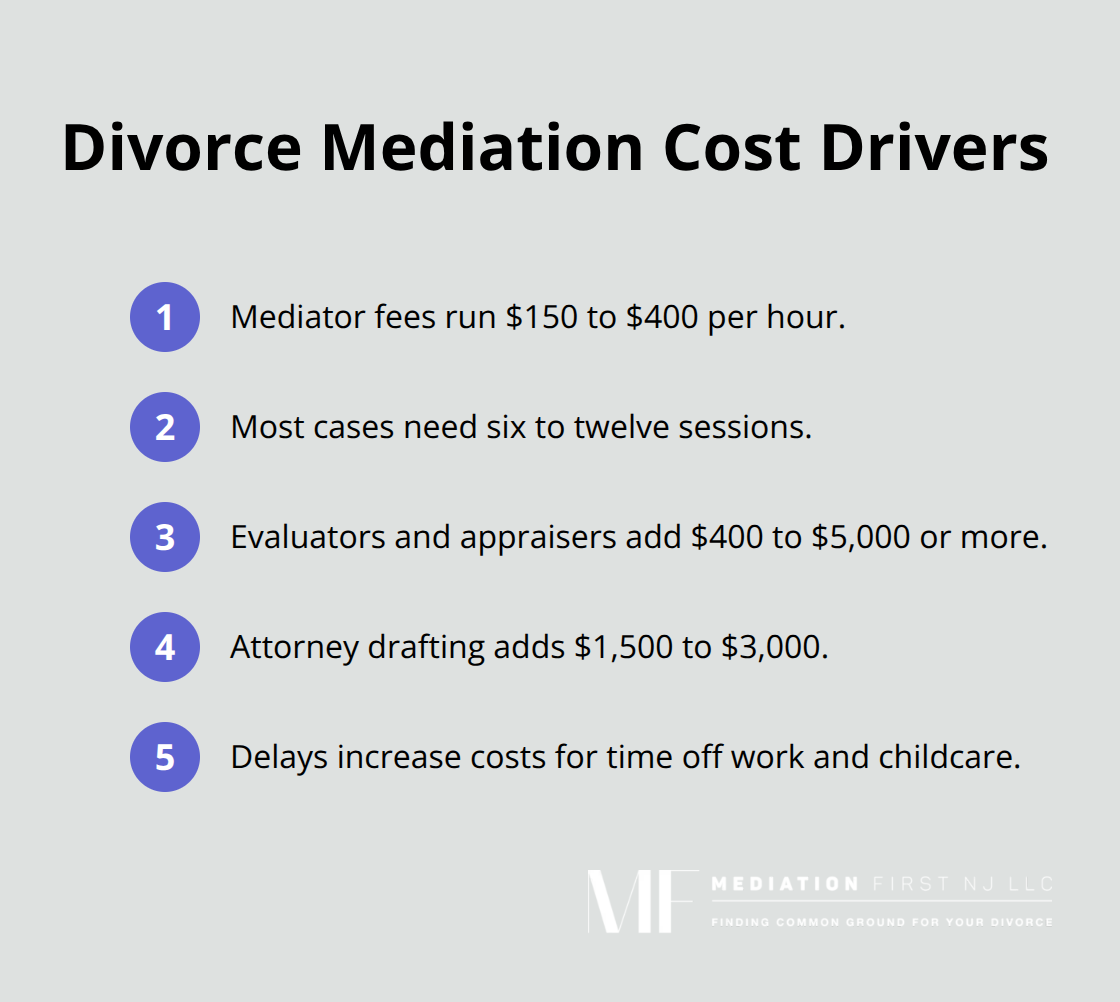
A single mediator session typically costs between $150 to $400 per hour, depending on the mediator’s experience and location. Most divorce mediations require six to twelve sessions to reach partial or full agreement, which means you’ll spend $900 to $4,800 just for the mediator’s time. That figure arrives before you account for the hidden costs that destroy budgets entirely.
Many couples assume two or three meetings will suffice, then face shock when their case demands months of sessions with no resolution in sight.
Professional Evaluators and Appraisers Add Thousands
Custody disputes often require a child psychologist or parenting evaluator, which costs $2,000 to $5,000 or more. Real estate appraisals run $400 to $1,000 each. Forensic accountants use various methods, such as analyzing financial statements, tax returns and bank records, to uncover hidden assets. One spouse hiding assets or undervaluing a business transforms a mediation that was supposed to save money into an expensive nightmare where you pay for the mediator, the evaluators, and eventually the litigation you tried to avoid.
Attorney Fees Arrive Even When You Tried to Avoid Them
The real financial trap emerges when mediation stalls and you still need attorneys. Even if you attempted to mediate without legal representation, you’ll eventually need a lawyer to draft the settlement agreement into a legally binding consent order, which costs $1,500 to $3,000 in attorney fees. If mediation fails entirely after six months of sessions, you’ve spent thousands on a process that produced no agreement, and you’re now starting litigation from zero with fresh court filing fees, discovery costs, and expert witness fees all over again.
Time Delays Compound Your Expenses
The timeline problem multiplies the expense: mediation that drags on for eight months without resolution costs more in mediator fees than a faster court process might cost in total. You also pay for your own time away from work, childcare during sessions, and the emotional toll of prolonged uncertainty. If your spouse uses mediation tactics to delay, withhold information, or simply refuse movement on key issues, you absorb all those costs with nothing to show for it. Litigation, while expensive, at least has discovery tools that force financial disclosure and move toward a definitive court date. Mediation has no such leverage, meaning a difficult spouse can string out sessions indefinitely while your bills accumulate.
These financial realities raise a harder question: whether the emotional and psychological toll of mediation justifies the costs when breakdowns occur.
The Emotional Toll of Sitting Across From Your Spouse
Mediation forces you to face your spouse directly across a table, sometimes for hours at a time. If your relationship involved criticism, contempt, or control, this proximity intensifies old wounds rather than healing them. Research on intimate partner violence shows that when those dynamics persist into divorce, mediation sessions become emotionally dangerous spaces where one spouse may intimidate or manipulate the other into unfavorable agreements.
Your Nervous System Reacts to Direct Confrontation
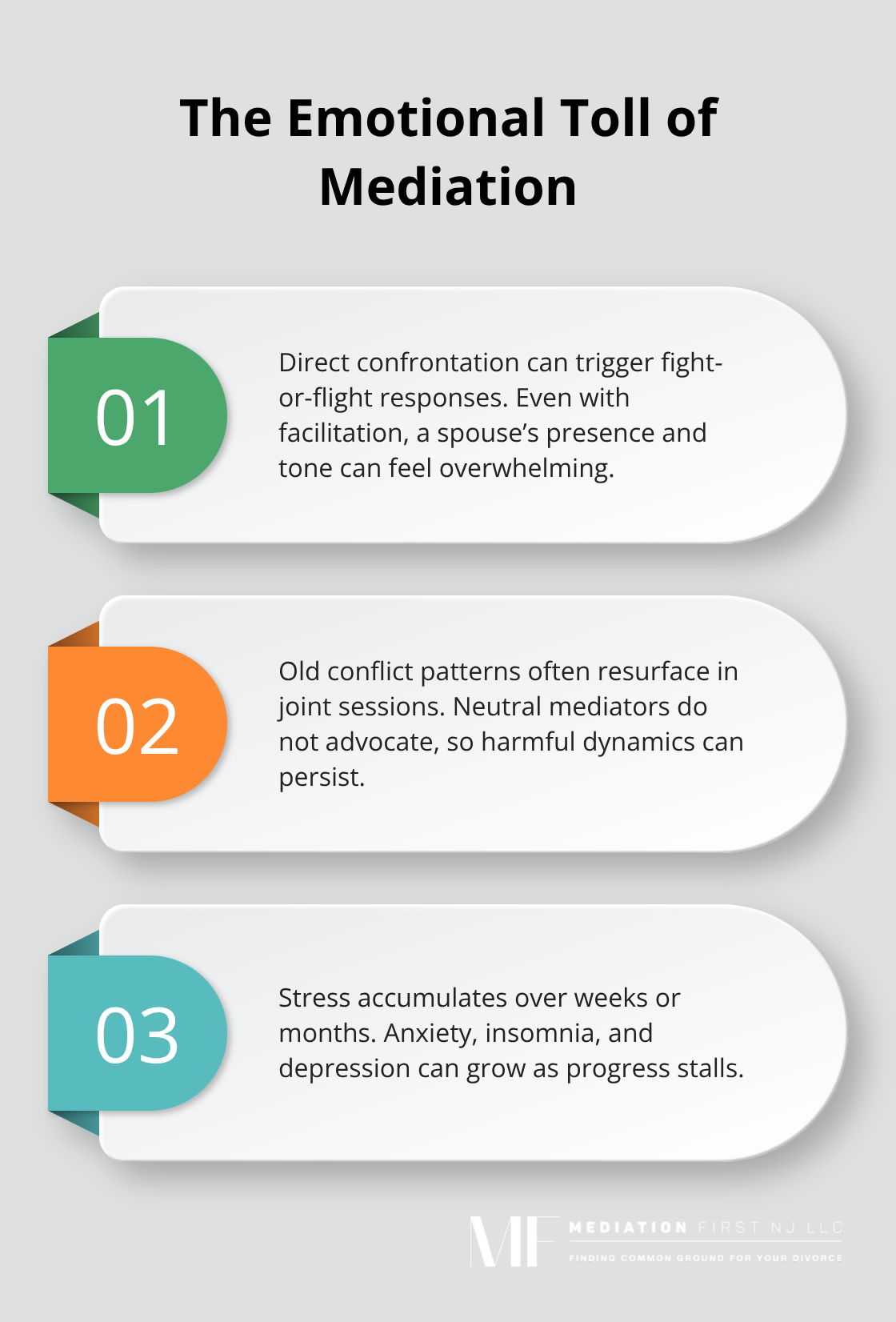
You sit there trying to negotiate custody or asset division while your nervous system activates fight-or-flight responses. The mediator facilitates conversation, but they cannot protect you from the emotional weight of your spouse’s presence, their dismissive tone, or their refusal to acknowledge your concerns. Without an attorney present to advocate for your interests and interrupt unfair dynamics, you absorb the full emotional impact alone. Many people leave mediation sessions feeling drained, unheard, or pressured into concessions they regret later.
Old Conflict Patterns Resurface in Joint Sessions
Managing emotions in joint sessions becomes nearly impossible when unresolved conflict dominates the room. If your marriage involved patterns of one spouse dominating discussions or shutting down communication, mediation replicates those exact dynamics. You may struggle to articulate your needs because your spouse interrupts, dismisses your perspective, or makes you feel foolish for raising legitimate concerns. The mediator’s role is neutral facilitation, not advocacy for either party, which means they will not challenge your spouse when they contradict themselves, hide information, or refuse to engage honestly.
Stress Accumulates Over Weeks and Months
Over multiple sessions spanning weeks or months, this emotional exhaustion accumulates. Some people experience anxiety before sessions, insomnia during the mediation process, and depression if the sessions drag on without progress. The longer mediation continues without resolution, the more your stress compounds.
If you have children, they sense this tension and may experience their own anxiety about the uncertain outcome.
The Psychological Cost Outweighs Financial Calculations
This psychological toll represents a genuine downside that cost calculations and timeline projections never capture, yet it shapes whether mediation actually produces workable agreements or simply prolongs suffering while both parties pay thousands for the privilege of reliving conflict repeatedly.
Final Thoughts
Despite the real downsides to divorce mediation we’ve outlined, mediation remains substantially cheaper than traditional litigation. Court battles involving discovery, depositions, expert witnesses, and trial preparation routinely cost $15,000 to $50,000 or more, while mediation typically ranges from $2,000 to $8,000 total. Even when mediation requires additional professionals or eventually leads to litigation, the initial cost savings often outweigh the expenses of starting in court from day one.
Mediation returns control to you and your spouse rather than handing decisions to a judge who decides custody arrangements, asset division, and support amounts based on state law and their interpretation of your case. You maintain agency over outcomes that profoundly affect your children and financial future. For parents, mediation’s greatest advantage emerges after the divorce concludes-co-parenting requires ongoing communication, flexibility, and mutual respect that litigation breeds resentment and adversarial positioning cannot support.
We at Mediation First NJ LLC understand that mediation works best when both parties commit to honest negotiation and when power imbalances or safety concerns don’t dominate the relationship. The downsides we’ve discussed are real, but they reflect situations where mediation may not be appropriate rather than failures of the process itself. For couples willing to engage constructively, mediation offers a faster, less expensive, and more collaborative path forward than courtroom battles.